Primary Immunodeficiency is a group of over 550 genetic disorders that cause one or more parts of the immune system to not work properly. People with Primary Immunodeficiency are more likely to get frequent and severe infections.
70-90% of people with Primary Immunodeficiency remain undiagnosed, so it is important to understand the signs for yourself, your family, and your community.
What are the symptoms of Primary Immunodeficiency?
The symptoms of Primary Immunodeficiency are different for children and adults.
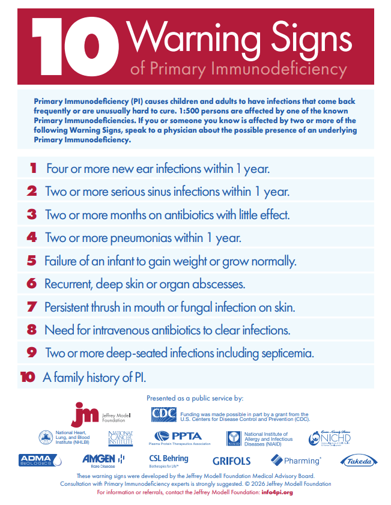
For children, the 10 Warning Signs of Primary Immunodeficiency are:
- Four or more new ear infections within one year
- Two or more serious sinus infections within one year
- Two or more months on antibiotics with little effect
- Two or more pneumonias withing one year
- Failure of an infant to gain weight or grow normally
- Recurrent, deep skin or organ abscesses
- Persistent thrush in mouth or fungal infection on skin
- Need for intravenous antibiotics to clear infections
- Two or more deep-seated infections including septicemia
- A family history of Primary Immunodeficiency
For adults, the 10 Warning Signs of Primary Immunodeficiency are:
- Two or more new ear infections within one year
- Two or more new sinus infections within one year (in the absence of allergy)
- One pneumonia per year for more than one year
- Chronic diarrhea with weight loss
- Recurrent viral infections (cold, herpes, warts, condyloma)
- Recurrent need for intravenous antibiotics to clear infections
- Recurrent, deep abscesses of the skin or internal organs
- Persistent thrush or fungal infection on skin or elsewhere
- Infection with normally harmless tuberculosis-like bacteria
- A family history of Primary Immunodeficiency
How common is Primary Immunodeficiency?
It is estimated that up to 83 million people worldwide have Primary Immunodeficiency. Currently the median time from symptom onset to Primary Immunodeficiency diagnosis is 4 – 9.5 years.
At the Jeffrey Modell Foundation we are committed to ending this diagnostic odyssey and ensuring earliest possible diagnosis for every person living with Primary Immunodeficiency. Our work to support early diagnosis includes increasing awareness of the 10 Warning Signs of Primary Immunodeficiency, expanding diagnostic tools like newborn screening, and physician and nurse education.
What should I do if I have symptoms of Primary Immunodeficiency?
If you or someone you know experience two or more of the 10 Warning Signs speak with an immunologist about the possibility of an undiagnosed Primary Immunodeficiency.
Find an immunologist near you with our Find An Expert Immunologist tool.